
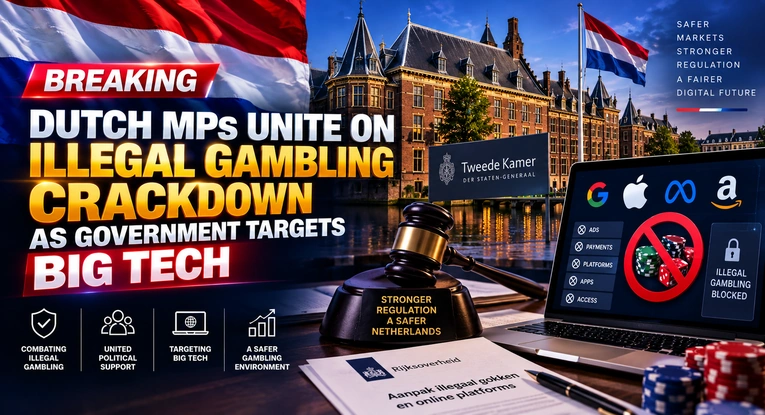
Dutch lawmakers are calling for tougher action against the country’s illegal gambling market, with the government preparing new measures while maintaining dialogue with major technology platforms over the spread of unlicensed gambling advertising.
The issue dominated a recent parliamentary Gambling Committee debate, where parties across the political spectrum backed stronger enforcement against illegal operators. The government also confirmed that discussions with Meta and Google will continue as authorities look for ways to curb illegal gambling promotions on social media and online platforms.
DNS blocking legislation in preparation
Justice State Secretary KT van Bruggen told MPs that the government is working on legislation that would allow DNS blocking of illegal gambling websites.
A public consultation is expected in early 2027, potentially giving Dutch authorities a faster way to restrict access to unlicensed operators.
MPs also called for tougher measures against payment providers, affiliates and social media platforms that help illegal gambling businesses reach Dutch consumers.
The calls come amid growing concern over the size of the unlicensed market, with the Kansspelautoriteit (KSA) previously estimating that channelisation has fallen below 50%.
Meta and Google under pressure
Illegal gambling advertising on social media was another major focus of the debate.
Van Bruggen said both Meta and Google were open to discussions with the Dutch government. Under the proposed approach, the government would receive reports every six months covering illegal gambling advertising appearing across the platforms.
She also argued that the issue cannot be tackled by the Netherlands alone and should be addressed at EU level through the Digital Services Act.
VVD representatives, however, urged the government to take a tougher position towards Big Tech companies and their role in distributing illegal gambling promotions.
The advertising issue has already triggered action from the Dutch gambling sector, with industry representatives pursuing legal measures against Meta over the volume of unlicensed gambling ads reaching Dutch users.
Gambling age could rise to 21
The parliamentary debate also revived calls to increase the legal gambling age from 18 to 21.
SGP MP Diederik van Dijk and CDA MP Tijs van den Brink were among those supporting the change, while Van Dijk went further by calling for the Netherlands to reverse its 2021 online gambling liberalisation and introduce a broader ban on gambling advertising.
The government is not ready to make the age increase immediately, however.
Van Bruggen said authorities first need to establish whether raising the age could unintentionally push younger players towards unlicensed operators. The issue will be reviewed in future progress reports.
Illegal market takes priority
For now, the Dutch government is putting enforcement against the black market ahead of a potential gambling-age increase.
The strategy reflects a wider concern that stricter rules for licensed operators could become counterproductive if consumers simply move to unlicensed websites.
Van Bruggen said the priority is to bring the illegal offer under control before deciding whether an age increase is necessary.
If the government succeeds in reducing the illegal market without creating a new channelisation problem, the proposal to raise the gambling age to 21 could return to the political agenda.
For the Dutch gambling sector, the next major test will therefore be whether tougher enforcement, new blocking powers and closer cooperation with Big Tech can restore confidence in the regulated market.