
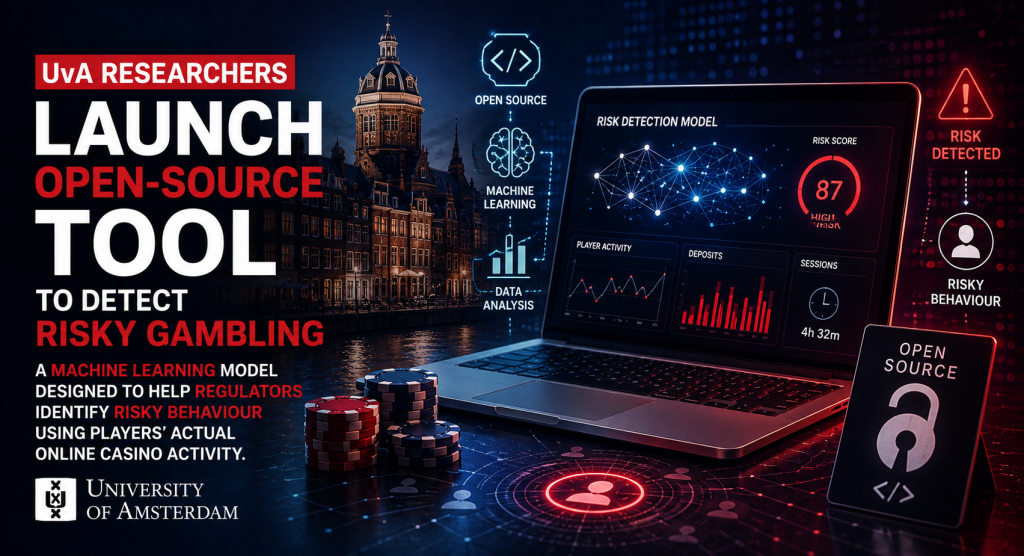
Researchers at the University of Amsterdam (UvA) have developed an open-source machine learning model designed to help regulators identify risky gambling behaviour using players’ actual online casino activity.
The project could give gambling regulators a new way to assess player protection independently from the risk-monitoring systems developed by operators themselves.
The model was made publicly available through the Kansspelautoriteit (Ksa) on 18 August, allowing regulators, researchers and other relevant organisations to examine and use the technology.
Built on two years of real player data
The research behind the model is notable for the scale of the data involved.
Researchers analysed betting activity from 13 Dutch online casinos over a two-year period, covering approximately 30 July 2023 to 30 July 2025.
The data was made available under a Dutch legal provision requiring online gambling operators to provide player information for independent research.
According to the researchers, this is the first time an independent study has analysed betting data from this many online casinos over such an extended period.
Charles de Leau, a PhD candidate at UvA, developed the model alongside professors Reinout Wiers from Psychology and Johan Bollen from Computer Science.
What does the model look for?
Rather than relying on individual indicators, the algorithm examines patterns in how people actually gamble.
Among the factors considered are:
- how frequently and how much a player bets;
- the times at which gambling takes place, including repeated late-night sessions;
- sequences of wins and losses;
- changes in betting behaviour following wins or losses.
These behavioural signals are then used to generate a risk score that can indicate patterns associated with problematic gambling.
The model covers all forms of online gambling, rather than focusing exclusively on casino games or sports betting.
A potential new benchmark for regulators
One of the most significant aspects of the project is that the algorithm is open source.
Most existing player-risk monitoring systems are developed by gambling operators or commercial technology providers, meaning that regulators may have limited visibility into how the underlying models work.
An independent and publicly accessible model could provide regulators with a separate benchmark against which operator systems can be evaluated.
The Dutch Ksa could, for example, compare the risk assessments generated by the open-source model with those produced by gambling operators when examining whether companies are meeting their player-protection obligations.
The approach could also be adopted by regulators in other jurisdictions.
International interest in player protection
The project was developed with support from ZonMw, using funding from the Ksa’s Addiction Prevention Fund, and involved cooperation with Spain’s gambling regulator, the DGOJ.
The researchers believe the model could become particularly useful as online gambling continues to expand and regulators look for more effective ways of identifying potentially harmful behaviour at an early stage.
For the iGaming industry, the development also highlights a broader shift in responsible gaming: regulators are increasingly looking beyond operators’ own monitoring systems and towards data-driven, independently verifiable tools for assessing player risk.
By making the underlying code and methodology publicly available, the UvA project allows other researchers to scrutinise the model, reproduce its results and potentially develop it further.
Source: University of Amsterdam (UvA) / Kansspelautoriteit (Ksa)