
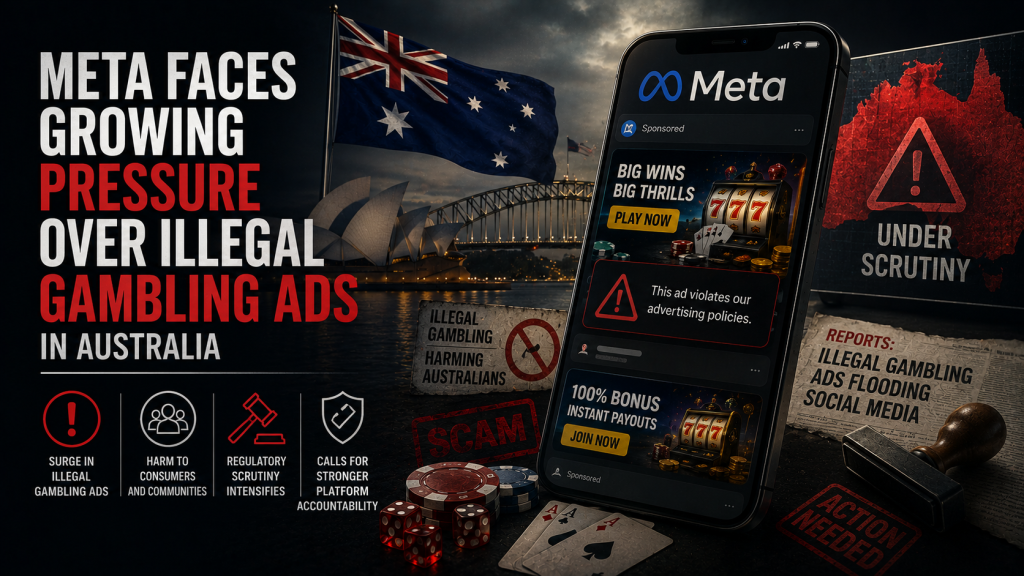
Meta is facing renewed scrutiny over gambling advertising on Facebook and Instagram after an investigation in Australia found that users were being exposed to promotions for unlicensed online casinos and scam gambling websites.
The issue has also highlighted a regulatory gap that currently limits the Australian Communications and Media Authority’s (ACMA) ability to force social media platforms to remove illegal gambling advertisements.
The controversy comes as Australia considers new legislation that could give regulators significantly stronger powers to tackle illegal gambling advertising and restrict access to offshore operators.
Facebook and Instagram accused of carrying illegal casino ads
An investigation published by the Sydney Morning Herald found advertisements promoting offshore gambling services on Meta’s platforms.
The promotions reportedly included online casino products, poker machine-style games, roulette and blackjack simulations, as well as websites designed to resemble established Australian casino brands.
Some advertisements allegedly directed users to so-called “scambling” websites, where players could deposit money but were unable to withdraw supposed winnings.
Affiliate marketers are also believed to play a significant role in promoting some of these services. According to the investigation, affiliates can receive commissions based on the losses generated by customers they refer to illegal gambling platforms.
The use of brand impersonation has added another layer to the problem. Crown Melbourne and Star were among the established brands reportedly impersonated by websites despite neither company operating an online casino in Australia.
Australian regulator faces legal limitations
ACMA has acknowledged that its ability to act against illegal gambling advertising is currently restricted by the country’s legislation.
Under the Interactive Gambling Act 2001, the regulator must establish that the majority of people accessing a particular gambling service are physically located in Australia before it can determine that an advertising breach has occurred.
That requirement is particularly difficult to satisfy when dealing with internationally hosted gambling platforms that attract users from multiple countries.
As a result, ACMA can currently ask Meta to remove problematic advertisements, but it does not have the same ability to compel the platform to take action.
New legislation could change the situation
The Australian government is looking to close that enforcement gap.
The Interactive Gambling Amendment (Gambling Reform) Bill 2026, introduced to federal parliament in July, would give ACMA additional powers to issue removal notices targeting illegal gambling advertisements appearing on online content services.
The proposed framework would go further by requiring internet service providers, DNS providers, app stores and search engines to block access to gambling services designated as illegal.
Banks and payment providers would also face new obligations to prevent transactions involving those services.
Most of the proposed measures are scheduled to take effect from January 1, 2027, although the legislation is currently undergoing parliamentary scrutiny.
Australia continues to target offshore gambling sites
The scale of ACMA’s existing enforcement activity illustrates the size of the challenge.
During the 2025-26 financial year, the regulator investigated 70 offshore gambling services and identified breaches in every case. Authorities also secured the blocking of 49 gambling websites.
The proposed legislation could therefore give regulators a more direct mechanism for dealing with both the operators themselves and the advertising networks helping them reach Australian consumers.
Meta faces similar criticism in Europe
Australia is not the only market where Meta is facing questions over gambling advertising.
In the Netherlands, licensed gambling industry association VNLOK launched legal action against Meta in June, while also submitting a complaint to the European Commission.
The organisation claims that tens of thousands of gambling advertisements targeting Dutch users appeared across Facebook and Instagram during the final quarter of 2025.
VNLOK estimates that more than 95% of those advertisements came from unlicensed gambling operators. Separate research commissioned by the organisation suggested that illegal gambling advertisements reached approximately 37.9 million Dutch users during March 2026, with people under the age of 24 accounting for a significant share of the impressions.
The Dutch case is based on the EU’s Digital Services Act, which places additional responsibilities on major online platforms to address illegal content appearing at scale.
VNLOK is seeking a court ruling that would establish Meta’s liability and require the company to comply with the relevant obligations, backed by financial penalties for non-compliance.
Meta points to wider industry responsibility
Meta has defended its approach by arguing that illegal gambling advertising is not a problem that can be solved by social media companies alone.
The company has called for greater cooperation between platforms, domain registrars, hosting companies and regulators capable of blocking illegal gambling websites at their source.
Meta also said it had disabled advertising accounts associated with the brand-impersonation activity identified in Australia and removed more than 159 million scam advertisements globally during the previous year.
Crown and Star have separately reiterated that they do not operate online gambling services and said they use specialist services to identify and address websites impersonating their brands.
Critics, however, argue that Meta already has the technological capabilities required to detect and prevent problematic gambling advertisements.
Lauren Levin of Gambling Policy Hub pointed to Meta’s ability to restrict similar advertising activity in markets such as Ireland and Indonesia.
Monash University gambling researcher Charles Livingstone made a similar argument, suggesting that Meta’s rapid response to copyright complaints demonstrates that the company is capable of identifying problematic content when sufficient pressure is applied.
Gambling regulators increasingly challenge social platforms
The dispute highlights a broader problem facing regulators: illegal gambling operators can operate across borders while advertising platforms reach consumers almost instantly.
Australia is now considering stronger legislation that would shift more responsibility onto technology companies and financial institutions. The Netherlands, meanwhile, is testing whether existing European legislation can already be used to hold major platforms accountable.
The outcome of both approaches could have implications well beyond these two markets.
As regulators around the world attempt to combat offshore gambling, the ability of social media platforms to prevent illegal operators from reaching consumers is likely to become an increasingly important part of the enforcement debate.