
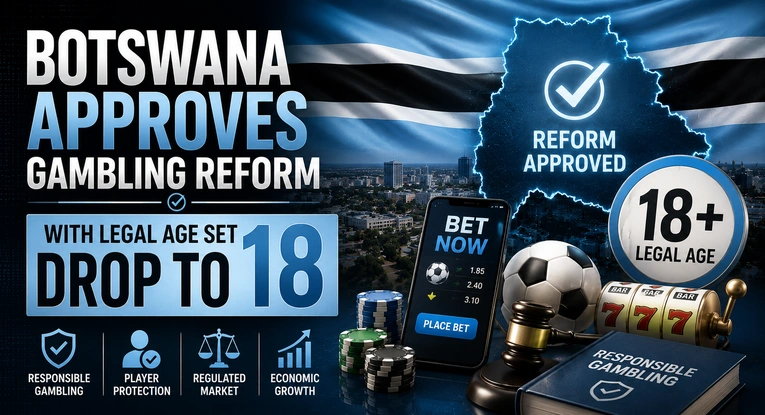
Botswana is moving ahead with a major overhaul of its gambling framework after Parliament approved a reform bill that would lower the legal gambling age from 21 to 18, while introducing tougher controls on operators and stronger measures against financial crime.
The Gambling (Amendment) Bill, 2026 passed its third reading on 13 August following detailed committee discussions. However, the legislation has not yet been confirmed as having received presidential assent, meaning the changes are not yet in force.
If enacted, the bill would amend Botswana’s Gambling Authority Act and come into effect on a date set by the responsible minister and published in the Government Gazette.
Gambling age sparks debate
The decision to retain the proposed reduction in the minimum gambling age was one of the most controversial parts of the legislation.
The bill would replace references to the existing age of 21 with 18, bringing the gambling threshold in line with Botswana’s general age of majority.
Supporters argued that adults aged 18 to 20 already have broad legal and economic responsibilities and that maintaining a higher gambling age could push some consumers towards unlicensed platforms.
Opposition MPs disagreed, warning that younger adults could be more vulnerable to gambling addiction.
Labour and Home Affairs Minister Major General Pius Mokgware also urged lawmakers to consider whether new rules could actually be enforced, warning against legislation that authorities would struggle to implement effectively.
Illegal betting remains a major concern
The reform comes as Botswana faces growing pressure from unlicensed online betting platforms.
Acting Gambling Authority CEO Moruntshi Kemorwale has previously warned that illegal betting could be diverting an estimated P850 million (around US$63.2 million) from the country’s economy each year.
Authorities have also raised concerns about children and teenagers accessing unregulated gambling services.
At the same time, the regulator says there have been improvements in problem gambling rates. Kemorwale reported that the share of reported problem gamblers fell from 5% in 2020 to 3.4% in 2025, which he attributed partly to Botswana’s National Responsible Gambling Programme and public education efforts.
New AML requirements for operators
The bill also seeks to bring Botswana’s gambling framework closer to Financial Intelligence Act requirements and Financial Action Task Force standards.
Proposed measures include stronger rules around beneficial ownership, financial interests, controlling interests, fit-and-proper assessments and know-your-customer checks.
Operators would also need approval from the Gambling Authority before acquiring a direct or indirect financial or controlling interest of 5% or more, unless a lower threshold is introduced.
The legislation would further expand electronic monitoring requirements. Most licence holders would have to connect gambling machines and devices at their premises to the Gambling Authority’s monitoring system, while casino and bingo operators would be required to install their own monitoring systems.
Tougher penalties on the way
Botswana is also preparing to increase sanctions for gambling-related breaches.
Under the bill, certain violations could attract a fine of up to P100,000, imprisonment for as long as five years, or both.
The legislation would also strengthen procedural protections for licence holders by requiring the Gambling Authority to give operators an opportunity to be heard before suspending, revoking or refusing to renew a licence.
Responsible gambling concerns remain
Despite the proposed lower age limit, responsible gambling remains a major theme in the reform debate.
Environment and Tourism Minister Dr Wynter Mmolotsi called for a dedicated rehabilitation facility for people experiencing gambling harm and suggested that Botswana consider technology capable of identifying prolonged gambling sessions and potentially harmful betting patterns.
Kgatleng Central MP Mpho Morolong meanwhile argued that gambling should be presented as entertainment rather than a way of making money.
The debate highlights the tension at the heart of Botswana’s reform: expanding and formalising a growing gambling market while trying to keep vulnerable consumers away from harmful play.
A fast-growing market
Botswana’s regulated betting sector has expanded rapidly in recent years, particularly following the introduction of licensing for bookmakers and totalisator operators.
The Gambling Authority previously estimated that only around 40% of the country’s estimated 550,000 active bettors were using licensed local operators, leaving a substantial portion of betting activity with unregulated platforms.
The authority has also reported strong growth in gambling revenue, with the sector surpassing P700 million by December 2025 and expectations that industry revenue could exceed P1 billion during the 2026/27 financial year.
With Parliament now backing the reforms, attention turns to presidential assent and implementation. If the bill becomes law, Botswana’s gambling sector will enter a new phase — with a lower legal age, tighter financial controls, stronger monitoring and an even greater focus on bringing online betting activity into the regulated market.