
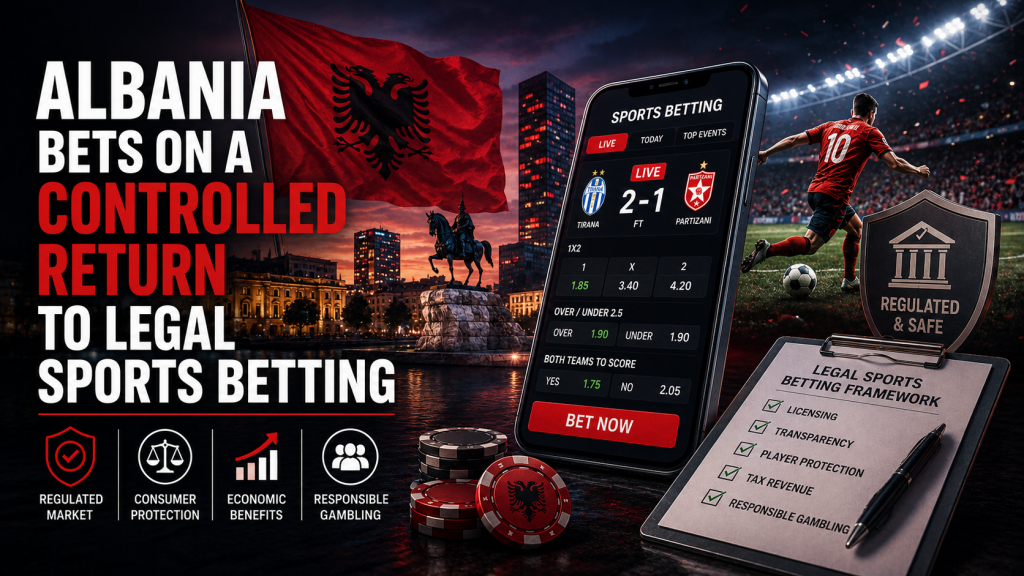
Online-only market could open the door to international operators after seven-year prohibition
Albania is moving closer to reopening its sports betting market, with a new regulatory framework expected to allow up to 10 online operators to offer betting services in the country.
The move marks a major shift after seven years of prohibition. Since 2019, Albania has banned betting shops, slot halls and online gambling, but the restrictions failed to eliminate demand. Instead, sports betting increasingly moved into the unregulated online market.
Industry estimates suggest that illegal online sports betting generated around $126 million in gross gaming revenue (GGR) in 2025. Including online casino and poker, total unregulated online GGR is estimated to have reached approximately $229 million.
Now, authorities are attempting to bring at least part of that activity back into a regulated environment.
From a complete ban to a limited reopening
Albania’s decision to prohibit sports betting was driven by concerns over gambling addiction, the rapid expansion of betting shops and the potential links between gambling and organised crime.
The scale of the market was considerable before the ban. In 2018, annual betting turnover was estimated at around €700 million, with approximately 4,000 betting shops operating across a country of fewer than three million people.
The government subsequently concluded that prohibition had not achieved its intended objective.
Prime Minister Edi Rama acknowledged in 2022 that online betting remained widespread despite the ban, arguing that the activity needed to be moved away from the black market and into a regulated system.
Parliament approved legislation allowing a partial reopening in 2024, but the detailed regulatory framework took more than two years to complete.
That process was finally brought closer to completion in July 2026, when Albania’s Gambling Supervision Authority confirmed that the eight implementing regulations required for the new market had been finalised.
Albania wants betting online, not back on the high street
The new regime is deliberately different from the market that existed before the ban.
Retail betting shops and slot halls will remain prohibited. Casinos will continue to be restricted to a limited number of locations within five-star hotels.
The reopening will therefore focus exclusively on online sports betting.
Authorities plan to allow up to 10 operators, although the final number will be determined by the Licensing Commission when the application process begins.
The government expects the regulated market to generate approximately ALL2 billion, or around €20 million, in annual public revenue. A 15% share of GGR will be directed towards a special fund supporting culture, sport, technology and innovation.
Whether the market can generate sufficient demand after seven years of prohibition remains one of the biggest questions.
Some local observers believe the appetite for betting has weakened during the ban, particularly among younger generations. Others point to the continued size of Albania’s illegal online market as evidence that demand has never disappeared.
Digital controls will be at the heart of the system
Albania’s decision to reopen betting exclusively online also gives regulators greater scope to monitor customers and transactions.
Players will have to register using a national identity card, while cash betting will not be permitted. Payments will need to pass through Albanian banks, licensed electronic money institutions or authorised payment providers.
Operators will be required to monitor transactions and retain player records for at least three years.
Responsible gambling requirements are also being built into the framework. Licensed companies will have to enforce Albania’s national self-exclusion register and provide customers with information about gambling risks, winning probabilities and available support services.
The framework reportedly goes further by allowing family members to request that a relative be excluded from gambling.
However, Albania’s support infrastructure remains limited. The country currently does not have a dedicated gambling counselling or rehabilitation centre, raising questions about whether the responsible gambling framework will be matched by adequate treatment services.
Licence requirements favour experienced international groups
For international operators, Albania’s entry requirements could prove demanding but potentially attractive.
Applicants must establish an Albanian joint-stock company and demonstrate gambling experience in at least three EU or OECD markets. They must also report turnover of at least ALL2 billion, approximately €20 million, for the previous financial year and maintain minimum share capital of ALL40 million, or around €400,000.
The licensing competition will operate through a points-based system.
The licence fee bid can account for up to 30 points, while another 30 points will be awarded for gambling industry experience. Governance and organisational structure can contribute 20 points, technology and software 15 points, and the applicant’s three-year business plan the remaining five points.
The licence fee itself will be determined through bidding but cannot fall below ALL400 million, approximately €4 million. The amount will be paid in instalments over the 10-year licence period.
These conditions could make the market difficult for smaller domestic businesses to enter.
Instead, they appear particularly well suited to established international operators with existing regulatory experience, sufficient capital and operations across multiple jurisdictions.
A competitive process could be coming soon
Once the Licensing Commission formally decides to launch the process, it will have seven days to publish a call for applications.
The announcement must appear on the Commission’s website, in Albania’s Public Notices Bulletin and in two international newspapers, indicating that the authorities expect international participation.
Yet the most important question remains unanswered: when will applications actually open?
Although the implementing regulations have now been completed, Albanian authorities have not provided a definitive timetable for the first licensing round.
The uncertainty is notable given that the legislation allowing the reopening was approved more than two years ago.
International operators face an opportunity — but also uncertainty
Albania’s regulated market will be relatively small, particularly when measured against major European betting jurisdictions. The country’s population is around 2.75 million and average incomes remain comparatively low.
At the same time, the existence of a substantial unregulated betting market suggests there is already a customer base familiar with online wagering.
For operators, the combination of an online-only model, a limited number of licences and relatively manageable ongoing costs could make Albania an interesting market entry opportunity.
The challenge will be converting players from established unregulated platforms to newly licensed operators.
The government will also need to demonstrate that the regulated market can compete effectively with offshore alternatives while maintaining strong enforcement against illegal operators.
Albania’s next gambling test
The reopening represents an unusual experiment for a European gambling market: after attempting to suppress betting almost entirely, Albania is now trying to capture existing demand through a tightly controlled online framework.
The seven-year ban has changed the market, however, and it is impossible to know how much of the previous betting culture remains.
If the Licensing Commission moves ahead with the process in the coming months, international operators could soon have an opportunity to compete for one of up to 10 licences.
For Albania, the bigger test will be whether those licences can successfully move a significant share of betting activity out of the black market — without recreating the widespread retail gambling environment that led to the original ban.
Source: European Gaming