
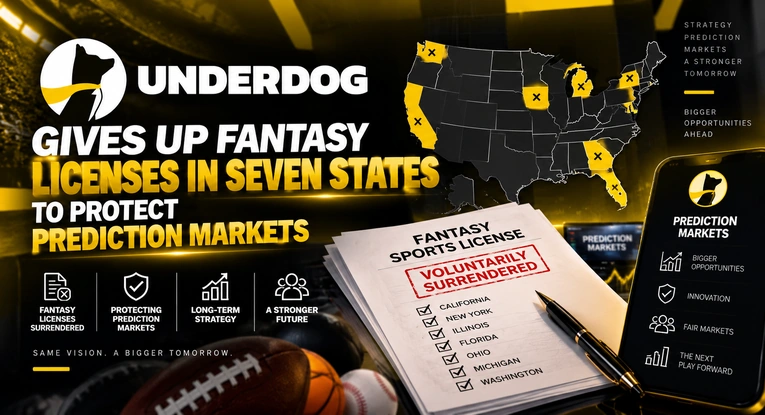
Underdog is giving up its daily fantasy sports licences in seven US states, choosing to protect its rapidly expanding prediction markets business as state regulators challenge the company’s ability to offer both products.
The New York-based operator will stop offering fantasy contests in Maryland, Massachusetts, Michigan, Mississippi, New Jersey, Ohio and Pennsylvania, including its popular Best Ball Drafts product.
The decision highlights an increasingly important regulatory battle in the US, where state gambling authorities and federally regulated prediction market operators are clashing over who has jurisdiction over sports-related contracts.
Prediction markets win the internal battle
Underdog founder and CEO Jeremy Levine said the company disagrees with the legal position taken by regulators in the seven states.
However, the company decided that maintaining access to its federally regulated prediction products was more important than retaining its state fantasy licences.
Fantasy contests will disappear from Mississippi on September 9 and from the other six states on September 10. Existing contests will continue and settle as normal.
Underdog’s Prediction Picks product will remain available in Maryland, Massachusetts, Mississippi, New Jersey, Ohio and Pennsylvania.
Michigan presents a different situation. The state is currently listed by Underdog as ineligible for Prediction Picks, meaning the company is surrendering its fantasy licence there despite not currently being able to offer its prediction product.
Underdog shifts away from its DFS roots
Underdog launched in 2020 as a daily fantasy sports operator, but prediction markets have increasingly become a central part of its strategy.
The company launched its own federally regulated prediction exchange in July after acquiring a CFTC-designated contract market and derivatives clearing organisation in March.
Before that move, Underdog offered prediction markets through third-party exchanges.
The latest decision shows just how far the company’s strategy has shifted. Rather than preserve its traditional fantasy business in seven states, Underdog is accepting the loss of those markets to keep its prediction offering intact.
The company has also indicated that it could restore its fantasy Drafts product if the regulatory environment changes.
State and federal regulators collide
At the centre of the dispute is the legal status of sports-related prediction contracts.
Prediction market operators argue that contracts offered through federally regulated exchanges fall under the exclusive jurisdiction of the Commodity Futures Trading Commission (CFTC) and federal commodities law.
State regulators and attorneys general have taken the opposite view, arguing that contracts based on sporting events effectively constitute wagering and should therefore remain subject to state gambling laws.
The conflict creates a particularly unusual situation for Underdog, which built its business in fantasy sports before moving into a market now challenging the regulatory boundaries that govern traditional gaming.
A calculated trade-off
Giving up seven fantasy licences represents a significant concession for one of the biggest names in the DFS sector, but Underdog appears willing to absorb the loss as it pursues the prediction market opportunity.
The company’s decision also underlines the growing pressure on US regulators to determine how state gambling laws should interact with federally regulated prediction markets.
For Underdog, the choice has been made: prediction markets take priority over its legacy fantasy business in the affected states.
As the state-federal jurisdictional dispute develops, the company’s move could become an important test case for other operators looking to enter the increasingly competitive US prediction market.