
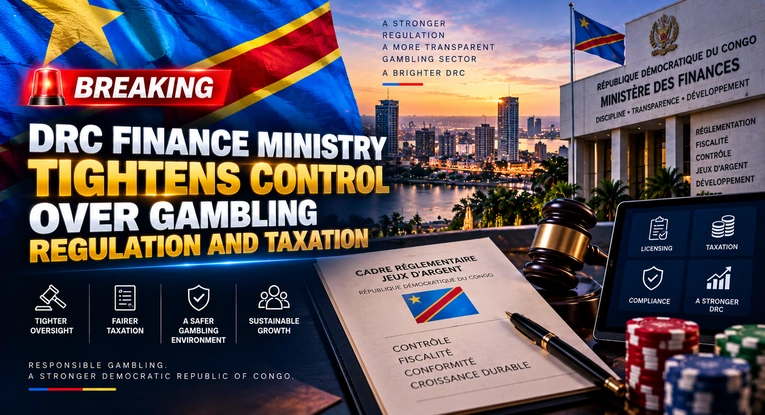
The Democratic Republic of Congo’s Ministry of Finance has reminded gambling operators that regulation, licensing and tax collection remain exclusively under its authority, warning businesses against relying on documents or payment demands issued by unauthorised bodies.
The warning applies across the gambling sector, including casinos, sports betting companies, lotteries and other gaming businesses operating in the country.
Operators told to deal directly with Finance Ministry
In a communiqué dated August 27, the ministry said operators must register with its designated offices, obtain the required authorisations and meet their tax obligations through legally recognised channels.
Any licence, tax assessment or control document issued by another institution has no legal effect, according to the ministry, and does not remove an operator’s obligations to the Treasury.
The government has also urged gambling companies to report irregular payment demands and avoid dealing with unauthorised services that could expose them to financial or legal consequences.
Gambling regulation moved under Finance Ministry
The latest warning follows reforms that have progressively centralised gambling oversight within the Ministry of Finance.
Changes adopted in April 2025 ended previous areas of overlap between the Finance Ministry and the Ministry of Sports and Leisure. A December 2025 ordinance subsequently formalised the transfer of responsibilities, including operator registration and sector supervision.
The 2023 Finance Law also placed key gambling-related revenues under the Finance Ministry, including authorisation fees and ad valorem taxes on player winnings.
The Directorate General of Administrative, Judicial, State Property and Participation Revenues (DGRAD) has been instructed to enforce compliance. Its responsibilities include cancelling irregular documents and referring cases for possible administrative, disciplinary or criminal action.
CSJA supports the new regulatory framework
The Finance Ministry is also relying on the Gambling and Games of Chance Monitoring Unit (CSJA), established in January 2026 as its technical arm for the sector.
The CSJA handles accreditation requests, monitors operators and supports gambling revenue collection. The government has also announced plans for a national platform designed to strengthen monitoring of gambling activity.
The latest warning follows the end of a pilot phase of the broader gambling-sector reform. Operators were previously given until July 31 to begin the compliance process, with the ministry warning that businesses failing to meet the requirements could face sanctions.
Focus on transparency and public revenue
The Finance Ministry said the reforms are intended to improve transparency, protect players, combat illegal practices and strengthen the collection of public revenue.
By reaffirming its exclusive regulatory role, the ministry is also seeking to eliminate uncertainty over which government bodies can issue gambling-related authorisations or demand payments.
For operators, the message is clear: compliance must go through the Finance Ministry and its officially designated services, with unauthorised documents and payment requests carrying no legal standing.