
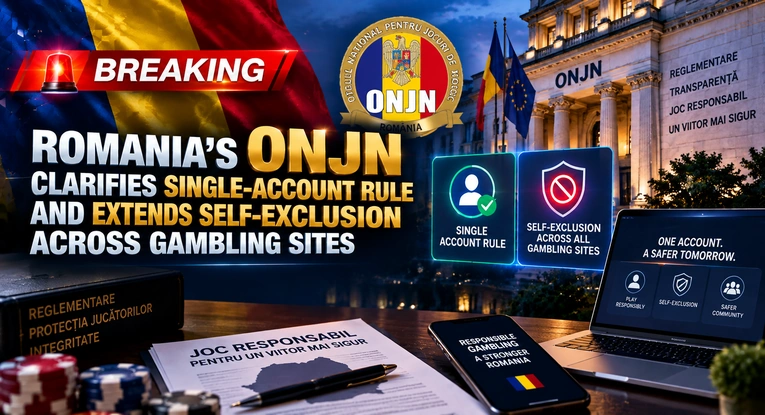
Romania’s gambling regulator has issued a major clarification on self-exclusion, confirming that players who exclude themselves from one gambling website operated under the same licence must also be blocked from all other domains belonging to that operator.
The National Office for Gambling (ONJN) published its clarification on March 13, addressing a long-running dispute over the so-called single-account principle and the treatment of players who were able to continue gambling on another platform operated by the same licence holder.
Under the framework established by Government Decision No. 111/2016, players are required to have a single account across platforms operated under the same licence. ONJN has now explicitly stated that self-exclusion must apply across the operator’s entire platform, rather than being limited to the individual website where the request was made.
One Self-Exclusion Must Cover Every Domain
According to ONJN, operators running gambling services across multiple internet domains must extend a player’s self-exclusion to all gambling accounts held by that person across their platform.
That means a player who activates self-exclusion through one of an operator’s websites should not be able to continue gambling simply by accessing another domain operated under the same licence.
The operator must also update its internal register so that the restriction applies across its entire operation and covers all relevant domains.
ONJN said operators must introduce specific procedures for handling these restrictions as part of their policies for preventing and combating gambling addiction.
Operators Must Update Their Terms and Procedures
The regulator also made clear that this is not simply a technical recommendation.
Operators are expected to incorporate the requirements into their responsible gambling policies and update their terms and conditions to reflect the rules already contained in Romanian legislation.
ONJN said its specialist department would undertake preventive measures to give operators a reasonable period in which to comply with the clarification.
The move puts greater responsibility on operators to ensure that information about a player’s self-exclusion is shared across their own network of gambling websites.
Dispute Over Players Who Continued Gambling
The clarification comes after disputes between players and operators over cases in which customers were able to gamble on multiple websites belonging to the same licence holder despite having requested self-exclusion.
Some operators had already started returning money to affected players, while others reportedly waited for an official position from ONJN before deciding how to handle such claims.
The regulator’s announcement now provides a clearer interpretation of how self-exclusion should operate across multiple domains.
However, the ONJN announcement itself does not establish a blanket refund rule for every player who gambled after self-exclusion. Individual claims for losses and potential reimbursements therefore remain a separate issue from the regulator’s clarification on how operators must apply self-exclusion.
A Significant Step for Player Protection
The decision could have a substantial impact on Romania’s online gambling market, particularly for operators running several brands or domains under a single licence.
Instead of treating each website as an isolated gambling account, the regulator’s interpretation requires operators to look at the player’s relationship with the wider platform.
The clarification strengthens the practical meaning of self-exclusion and closes a potential loophole in which a player could move from one domain to another after restricting access to their original account.
For Romanian operators, the message from ONJN is clear: a self-exclusion request made on one domain cannot simply stop at that domain when the other websites belong to the same licensed gambling platform.
Source: ONJN (Oficiul Național pentru Jocuri de Noroc)