

The Martingale Roulette Strategy is a betting system based on doubling your stake after every loss and returning to your original stake after a win.
The idea is simple: because even-money roulette bets such as red or black pay 1:1, one winning bet can recover all previous losses and leave a profit equal to the original stake. However, Martingale does not eliminate the house edge, and a sufficiently long losing streak can quickly exhaust a player’s bankroll or hit the table’s maximum betting limit.
That combination of simple rules, frequent small wins and potentially very large losses has made Martingale one of the most famous roulette betting systems in gambling history.
What Is the Martingale Roulette Strategy?
The Martingale system is a progressive betting strategy rather than a roulette prediction system.
The traditional version works like this:
- Choose an even-money bet, such as red or black.
- Set an initial betting unit.
- Place the initial stake.
- If the bet wins, return to the original stake.
- If the bet loses, double the next stake.
- Continue doubling after each consecutive loss until a winning bet occurs.
- After a win, reset the sequence to the starting stake.
For example, a player using a €10 starting stake would follow this progression:
€10 → €20 → €40 → €80 → €160 → €320 → €640 → €1,280
If the player loses the first three bets and wins the fourth, the result looks like this:
| Spin | Result | Stake | Net Result |
|---|---|---|---|
| 1 | Loss | €10 | -€10 |
| 2 | Loss | €20 | -€30 |
| 3 | Loss | €40 | -€70 |
| 4 | Win | €80 | +€10 |
The €80 winning bet generates €80 in profit. That recovers the €70 accumulated losses and leaves the player with the original €10 betting unit as profit.
This is the central idea behind Martingale.
The problem is that the required stake doubles every time the player loses.
How Does the Martingale System Work in Roulette?
Martingale is primarily associated with even-money roulette bets because these bets pay 1:1.
Common examples include:

A player betting €10 on red, for example, wins €10 if red appears and loses €10 if black or zero appears on a standard European roulette wheel.
After a loss, the next stake becomes €20.
After another loss, it becomes €40.
After another loss, €80.
The formula is straightforward:
Next stake = previous stake × 2
The total amount lost after a sequence of losses can be calculated as:
Initial stake × (2ⁿ – 1)
where n is the number of consecutive losses.
For a €10 starting stake:
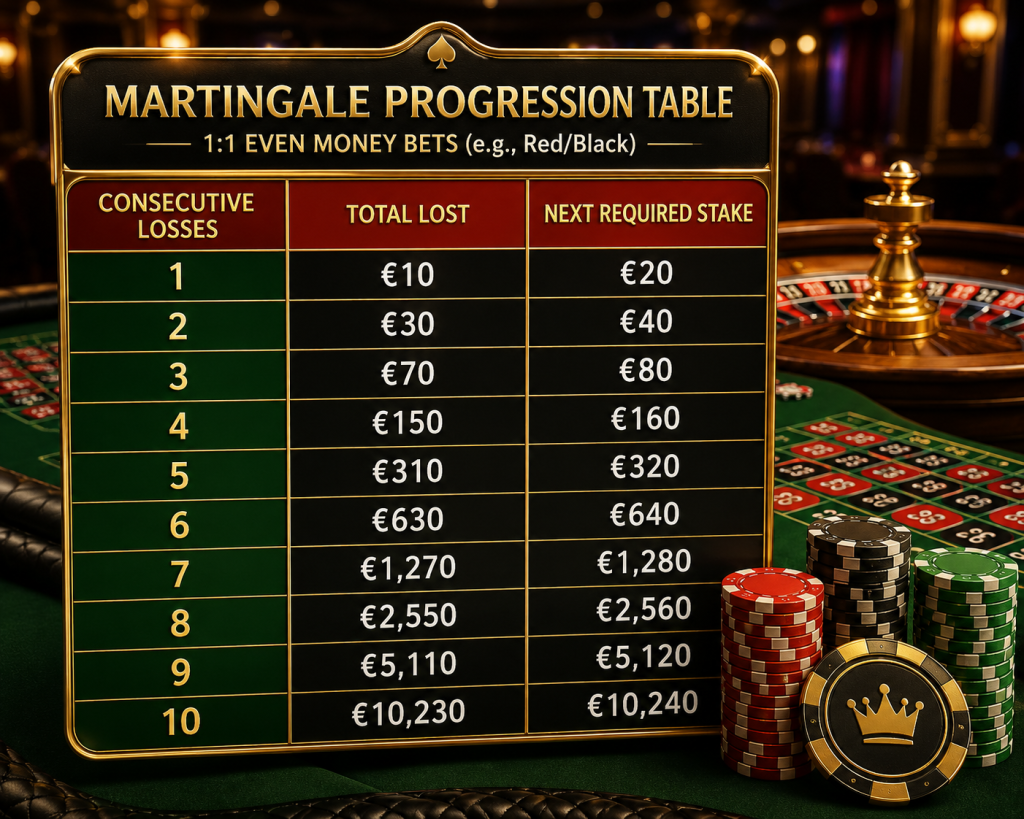
The table demonstrates the fundamental weakness of the system.
The potential profit remains €10, but the amount required to continue the strategy increases exponentially.
Martingale Roulette Probability
Understanding the probability behind roulette is essential before evaluating Martingale.
On a standard European roulette wheel there are 37 pockets:
- 18 red
- 18 black
- 1 green zero
A bet on red therefore wins on 18 of the 37 possible outcomes.
European Roulette Probability
| Outcome | Number of pockets | Probability |
|---|---|---|
| Red | 18 | 48.65% |
| Black | 18 | 48.65% |
| Zero | 1 | 2.70% |
| Red or Black | 36 | 97.30% |
For an individual red/black bet, the probability of winning is therefore 18/37 = 48.65%, while the probability of losing is 19/37 = 51.35%.
The important detail is the zero.
Although red and black each occupy 18 pockets, the additional zero means that the two sides do not add up to 100% as betting outcomes.
What Are the Odds of Losing Several Roulette Bets in a Row?
This is where Martingale becomes particularly interesting.
On European roulette, the probability of losing an even-money bet is 19/37, or approximately 51.35%.
The probability of losing twice consecutively is:
(19/37)² = 26.38%
For three consecutive losses:
(19/37)³ = 13.55%
The progression continues as follows:
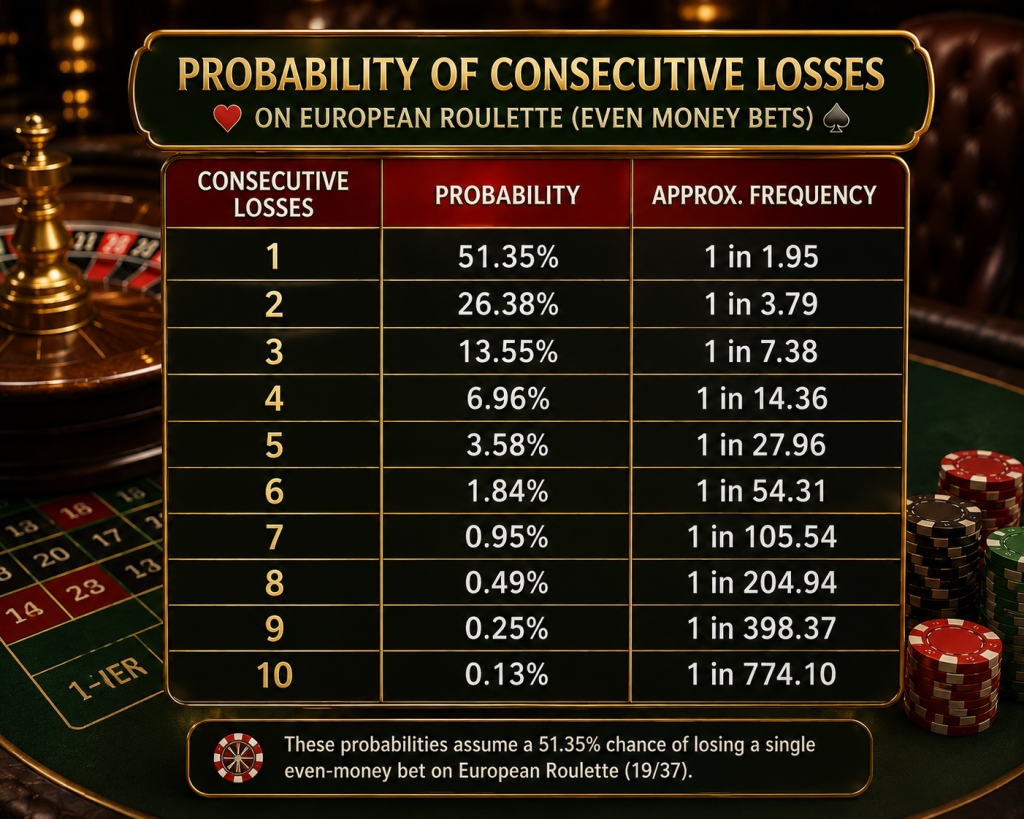
These figures help explain why Martingale can appear to work for a long time.
Short losing streaks are common, but longer streaks become progressively less likely.
However, unlikely does not mean impossible.
And a player does not normally play one isolated sequence. Over hundreds or thousands of spins, the opportunity for a long losing streak increases.
Why Does Martingale Appear to Work?
The strategy creates a psychological effect that makes it particularly attractive.
Imagine starting with a €10 stake.
You win.
+€10
Then you lose.
-€10
Then lose again.
-€20
Then lose again.
-€40
Finally, you win with an €80 stake.
The €80 winning bet recovers the €70 previously lost and leaves a €10 profit.
The complete sequence therefore ends:
+€10
The player has experienced three consecutive losses but still finished the sequence in profit.
This can create the impression that Martingale has somehow defeated the losing streak.
It has not.
The system has simply transferred the risk from many small bets into a much larger future bet.
The Main Problem With Martingale
The central problem is not that doubling fails mathematically.
It is that doubling cannot continue indefinitely.
There are two practical limits:
- The player’s bankroll.
- The casino’s maximum table limit.
Consider a player with a €1,000 bankroll using a €10 starting stake.
After six consecutive losses:
€10 + €20 + €40 + €80 + €160 + €320 = €630
Only €370 remains.
The next Martingale stake should be €640.
The player cannot place it without additional funds.
The strategy has therefore failed to recover the accumulated loss.
Martingale and Casino Table Limits
Even a player with a large bankroll eventually faces another problem: the table limit.
Suppose a roulette table has a €1,000 maximum bet.
A player starts with €10:
| Step | Stake |
|---|---|
| 1 | €10 |
| 2 | €20 |
| 3 | €40 |
| 4 | €80 |
| 5 | €160 |
| 6 | €320 |
| 7 | €640 |
| 8 | €1,280 |
After seven consecutive losses, the next required bet is €1,280.
The table allows only €1,000.
The player can no longer follow the Martingale progression.
This is one of the reasons why the theoretical argument that a player only needs a “large enough bankroll” is incomplete.
There is no infinite bankroll and no infinite table limit.
European vs American Roulette for Martingale
The type of roulette wheel matters.
European roulette has one zero, while American roulette has both zero and double zero.
| Roulette type | Total pockets | Zero pockets | Probability of winning Red/Black | House edge on standard even-money bets |
|---|---|---|---|---|
| European | 37 | 1 | 48.65% | 2.70% |
| American | 38 | 2 | 47.37% | 5.26% |
The European wheel is therefore mathematically preferable for players who want to study or use a Martingale system.
The reason is simple: there is only one green zero instead of two.
The American wheel gives the casino a significantly larger mathematical advantage.
Is French Roulette Better for Martingale?
Some French roulette tables use special rules such as La Partage.
Under La Partage, when zero appears on an even-money bet, the player can receive half of the stake back rather than losing the entire wager.
This can reduce the house edge on qualifying even-money bets.
| Roulette rule | House edge on even-money bets |
|---|---|
| French Roulette with La Partage | 1.35% |
| European Roulette | 2.70% |
| American Roulette | 5.26% |
This makes French Roulette with La Partage mathematically more favourable than standard European or American roulette for these bets.
However, the important point remains unchanged:
A lower house edge is not the same as a player advantage.
Martingale still does not create positive expected value.
Martingale and the House Edge
One of the biggest misconceptions surrounding roulette betting systems is the idea that changing the size of a bet can change the mathematical advantage of the game.
It cannot.
On European roulette, the standard house edge is approximately 2.70%.
A simple illustration:
| Total amount wagered | Approx. theoretical house advantage |
|---|---|
| €10 | €0.27 |
| €100 | €2.70 |
| €1,000 | €27 |
| €10,000 | €270 |
These figures describe long-run expected results rather than the outcome of an individual session.
Martingale changes when and how much money is wagered.
It does not change the underlying probability of the wheel.
Can Martingale Beat the House?
No, not as a betting system on a fair roulette wheel with a built-in house edge.
Martingale can produce a high percentage of winning sequences because many sequences end after a relatively short number of spins.
But the strategy pays for those frequent small wins by accepting the possibility of a much larger loss.
For example:
| Outcome | Profit/Loss |
|---|---|
| 1 successful Martingale cycle | +€10 |
| 10 successful cycles | +€100 |
| 50 successful cycles | +€500 |
| One failed cycle after 7 losses | -€1,270 |
| One failed cycle after 10 losses | -€10,230 |
The exact outcome depends on the starting stake, stopping rules and table limits, but the principle is universal.
A large number of small wins can be wiped out by one sufficiently long losing sequence.
Martingale and the Gambler’s Fallacy
Martingale is sometimes presented alongside another common misconception: the gambler’s fallacy.
Suppose black appears six times consecutively.
A player might think:
“Red is due.”
It is not.
The next roulette spin does not remember the previous six.
For European roulette, the probability of red remains:
| Bet outcome | Probability on next spin |
|---|---|
| Red | 48.65% |
| Black | 48.65% |
| Zero | 2.70% |
The previous sequence does not change those probabilities.
This is known as the independence of spins.
Martingale does not predict the next result.
It only changes the amount of money placed on it.
The History of the Martingale System
The Martingale concept predates modern online casinos by centuries.
The name is generally associated with betting systems used in France during the 18th century. The underlying idea was to increase the stake after a loss in the expectation that a future win would recover previous losses.
The strategy became particularly associated with games offering even-money outcomes.
Roulette was a natural environment for the system because of its red/black, odd/even and high/low bets.
The famous European casino culture of the 19th and early 20th centuries helped turn betting systems into part of gambling folklore.
Monte Carlo became especially famous for stories involving roulette systems, probability experiments and players attempting to identify patterns in apparently random sequences.
Historical accounts of roulette systems have included Martingale alongside other progressions such as D’Alembert, Fibonacci-style systems and numerous less-known betting methods.
The popularity of these systems reveals something important about gambling history.
The desire to find a staking method capable of overcoming roulette’s mathematics is far older than online gambling.
Martingale and Monte Carlo
Monte Carlo has a particularly strong connection with roulette mythology.
During the 19th century, the Casino de Monte-Carlo became one of Europe’s most famous gambling destinations.
Players watched the colours and numbers appearing on the wheel and attempted to identify exploitable patterns.
One of the most famous episodes occurred in 1913, when black reportedly appeared repeatedly at the Monte Carlo Casino. Players began betting heavily on red because they believed a red result had become increasingly likely.
It had not.
Each spin remained independent.
The famous episode became one of the classic examples of the gambler’s fallacy and helped reinforce the idea that roulette streaks could be exploited through betting systems.
The lesson remains relevant to Martingale today:
a losing streak does not make the opposite outcome “due.”
A Realistic Martingale Example
Consider a player with:
- Starting bankroll: €500
- Initial stake: €5
- Bet: Red
- Roulette: European
- Maximum table bet: €500
The theoretical progression is:
€5 → €10 → €20 → €40 → €80 → €160 → €320 → €640
The player can survive six consecutive losses because the cumulative loss would be:
€315
The seventh stake would be €320, leaving only €185 after losing it.
The next required bet would be €640.
That is impossible.
| Losing streak | Cumulative loss | Next stake | Can a €500 bankroll continue? |
|---|---|---|---|
| 1 | €5 | €10 | Yes |
| 2 | €15 | €20 | Yes |
| 3 | €35 | €40 | Yes |
| 4 | €75 | €80 | Yes |
| 5 | €155 | €160 | Yes |
| 6 | €315 | €320 | Yes |
| 7 | €635 | €640 | No |
The player could have many successful cycles before encountering this situation.
That is exactly what makes Martingale psychologically attractive.
But the bankroll determines how far the mathematical progression can actually go.
How Much Money Do You Need for Martingale?
There is no universal bankroll requirement because it depends on the starting stake and the number of consecutive losses you want to survive.
The required bankroll can be calculated as:
Bankroll = Initial stake × (2ⁿ – 1)
For example:

The numbers grow extremely quickly.
This is why reducing the starting stake does not solve the underlying mathematical problem.
It merely moves the numbers down the scale.
Martingale vs Other Roulette Betting Systems
Martingale is only one of several popular roulette betting systems.
| Strategy | Increase after loss? | Increase after win? | Main characteristic |
|---|---|---|---|
| Martingale | Yes | No | Doubles after losses |
| Reverse Martingale | No | Yes | Increases after wins |
| D’Alembert | Yes, gradually | Yes, gradually | Smaller progression |
| Fibonacci | Yes | Reset/reduce | Uses Fibonacci sequence |
| Paroli | No | Yes | Progressive winning strategy |
| Flat Betting | No | No | Same stake every spin |
None of these systems changes the underlying probability of the roulette wheel.
Their primary difference is risk distribution.
Some produce more frequent small wins.
Others seek larger wins during winning streaks.
Some expose the bankroll more aggressively after losses.
Others limit stake increases.
Martingale vs Fibonacci Roulette Strategy
The Fibonacci system increases stakes according to the Fibonacci sequence rather than doubling them.
A typical progression might look like:
€10 → €10 → €20 → €30 → €50 → €80 → €130
Compared with Martingale:
€10 → €20 → €40 → €80 → €160 → €320 → €640
The Fibonacci progression grows more slowly.
| Step | Martingale | Fibonacci |
|---|---|---|
| 1 | €10 | €10 |
| 2 | €20 | €10 |
| 3 | €40 | €20 |
| 4 | €80 | €30 |
| 5 | €160 | €50 |
| 6 | €320 | €80 |
| 7 | €640 | €130 |
| 8 | €1,280 | €210 |
The trade-off is that Fibonacci may require more winning bets to recover previous losses.
Again, neither system changes the house edge.
Martingale vs D’Alembert
The D’Alembert system is another progression associated with even-money bets.
Instead of doubling after every loss, the player increases the stake by one unit after a loss and decreases it by one unit after a win.
For example, with a €10 unit:
€10 → €20 → €30 → €40 → €30 → €20
This produces a much slower increase than Martingale.
However, slower progression also means that a winning bet may not immediately recover all previous losses.
The choice therefore becomes one of risk versus recovery speed.
Martingale prioritises rapid recovery.
D’Alembert prioritises slower stake growth.
Neither has a mathematical advantage over the roulette wheel.
Can You Use Martingale Responsibly?
If Martingale is used as an entertainment betting system, bankroll management remains essential.
A player should understand:
- the maximum amount they are prepared to lose;
- the table limit;
- the maximum number of Martingale steps;
- the starting stake;
- the potential size of the final wager;
- the fact that previous spins do not influence future probabilities.
A stop-loss can prevent a progression from consuming an entire bankroll.
For example, a player might decide before starting that the Martingale sequence ends after five consecutive losses.
This does not make the strategy profitable.
It simply places a predefined limit on the potential damage.
Does Martingale Work on Online Roulette?
The mathematics is the same whether roulette is played online or in a physical casino, provided the game uses the same rules and probabilities.
For a standard European roulette game:
| Factor | European Roulette |
|---|---|
| Total pockets | 37 |
| Red pockets | 18 |
| Black pockets | 18 |
| Zero pockets | 1 |
| Red/Black win probability | 48.65% |
| Red/Black loss probability | 51.35% |
| Standard house edge | 2.70% |
Online roulette can offer additional variations, including European, French and American roulette, as well as live dealer games.
The important factor is not whether the game is online or land-based.
It is which roulette rules apply.
What Happens After a Zero in Martingale?
For a standard even-money bet on European roulette, zero is a losing outcome.
Suppose the sequence is:
Red → Red → Red → Zero
A player betting red loses on zero and must therefore continue the progression.
For a €10 starting stake:
| Spin | Result | Stake | Next stake |
|---|---|---|---|
| 1 | Red | €10 | €10 |
| 2 | Red | €10 | €10 |
| 3 | Red | €10 | €10 |
| 4 | Zero | €10 | €20 |
The zero therefore matters because it is an additional losing result for red/black bets.
Under La Partage, however, the treatment of zero can be different for qualifying even-money wagers.
Is Martingale a Good Roulette Strategy?
That depends on what “good” means.
If the goal is a simple system that is easy to understand, Martingale is one of the most straightforward betting progressions ever developed.
If the goal is to create a mathematical advantage over the casino, it does not achieve that.
If the goal is to limit exposure to large losses, Martingale can actually be problematic because the required stake grows exponentially.
The system therefore makes more sense as a case study in probability and bankroll management than as a guaranteed winning strategy.
The Biggest Martingale Mistake
The biggest mistake is assuming that a long losing streak is unlikely enough to ignore.
Suppose a player says:
“I’ve played hundreds of spins and never had ten losses in a row.”
That observation does not prove that the next long streak cannot happen.
The roulette wheel has no memory.
Every spin presents the same underlying probabilities.
The danger is that Martingale requires the player to have enough money to survive precisely the event that they consider unlikely.
This is the core mismatch:
The event is unlikely, but the financial consequence is enormous.
Martingale Roulette Strategy: Final Verdict
The Martingale Roulette Strategy remains popular because its logic is immediately understandable.
Lose → double the stake → win → recover the previous losses → reset.
On a 1:1 bet, the mathematics of a single successful sequence works exactly as advertised.
But the system has a fundamental limitation.
Roulette outcomes are independent, the house has a mathematical edge, bankrolls are finite and casino tables have maximum betting limits.
On European roulette, a red or black bet wins only 48.65% of the time, while the probability of losing is 51.35%. The house edge on standard even-money bets is approximately 2.70%.
The Martingale system cannot change those numbers.
Its real effect is to redistribute risk.
Instead of accepting many small losses, the player increases the next wager dramatically in an attempt to recover them. That can lead to many profitable-looking sequences, but a sufficiently long losing streak can produce a disproportionately large loss.
For example, a €10 starting stake requires a €10,240 wager after ten consecutive losses, while €10,230 has already been lost.
That is the fundamental weakness of Martingale.
It can change the pattern of your wins and losses, but it cannot change the mathematics of roulette.
For players interested in roulette strategy, the most useful approach is therefore to understand the probabilities, house edge, table limits and bankroll requirements before considering any betting progression.
Frequently Asked Questions About Martingale Roulette Strategy
What is the Martingale Roulette Strategy?
The Martingale Roulette Strategy is a progressive betting system where the player doubles their stake after every loss and returns to the original stake after a win. It is usually applied to 1:1 bets such as red/black or odd/even.
Does the Martingale strategy actually work?
Martingale can produce winning sessions and successful betting sequences, but it cannot guarantee long-term profit. The strategy does not remove the casino’s mathematical advantage.
What is the probability of winning red or black in European roulette?
The probability of winning a red or black bet is 18/37, or 48.65%.
What is the probability of losing red or black?
On European roulette, the probability of losing a red or black bet is 19/37, or 51.35%, because both the opposite colour and zero result in a losing outcome.
How many times can you double in Martingale?
There is no universal number. The practical limit depends on the player’s bankroll and the casino’s maximum table bet. Because stakes double exponentially, even a small number of consecutive losses can require a very large wager.
Can Martingale beat roulette?
No. Martingale cannot eliminate the house edge. It changes the staking pattern rather than the probability of the roulette wheel.
What happens after 10 Martingale losses?
With a €10 starting stake, ten consecutive losses would result in €10,230 in cumulative losses and require a €10,240 next bet to continue the progression.
Is European roulette better than American roulette for Martingale?
Yes, from a mathematical perspective. European roulette has one zero and a standard house edge of approximately 2.70%, while American roulette has two zeros and a house edge of approximately 5.26%.
Is Martingale better than Fibonacci?
Neither strategy has a mathematical advantage over the roulette wheel. Martingale increases stakes much faster, while Fibonacci uses a slower progression and therefore exposes the bankroll differently.
What is Reverse Martingale?
Reverse Martingale increases the stake after a win rather than after a loss. It is designed to take advantage of winning streaks instead of attempting to recover losses.
Is Martingale safe?
No betting system can make roulette risk-free. Martingale can create particularly large exposure because the required stake doubles after every loss. Bankroll and table limits can prevent the strategy from completing its recovery cycle.
What is the best roulette strategy?
There is no betting progression that guarantees a mathematical advantage over a fair roulette game with a house edge. Players comparing strategies should focus on probability, house edge, bankroll management and the rules of the roulette variant rather than claims of guaranteed profits.